
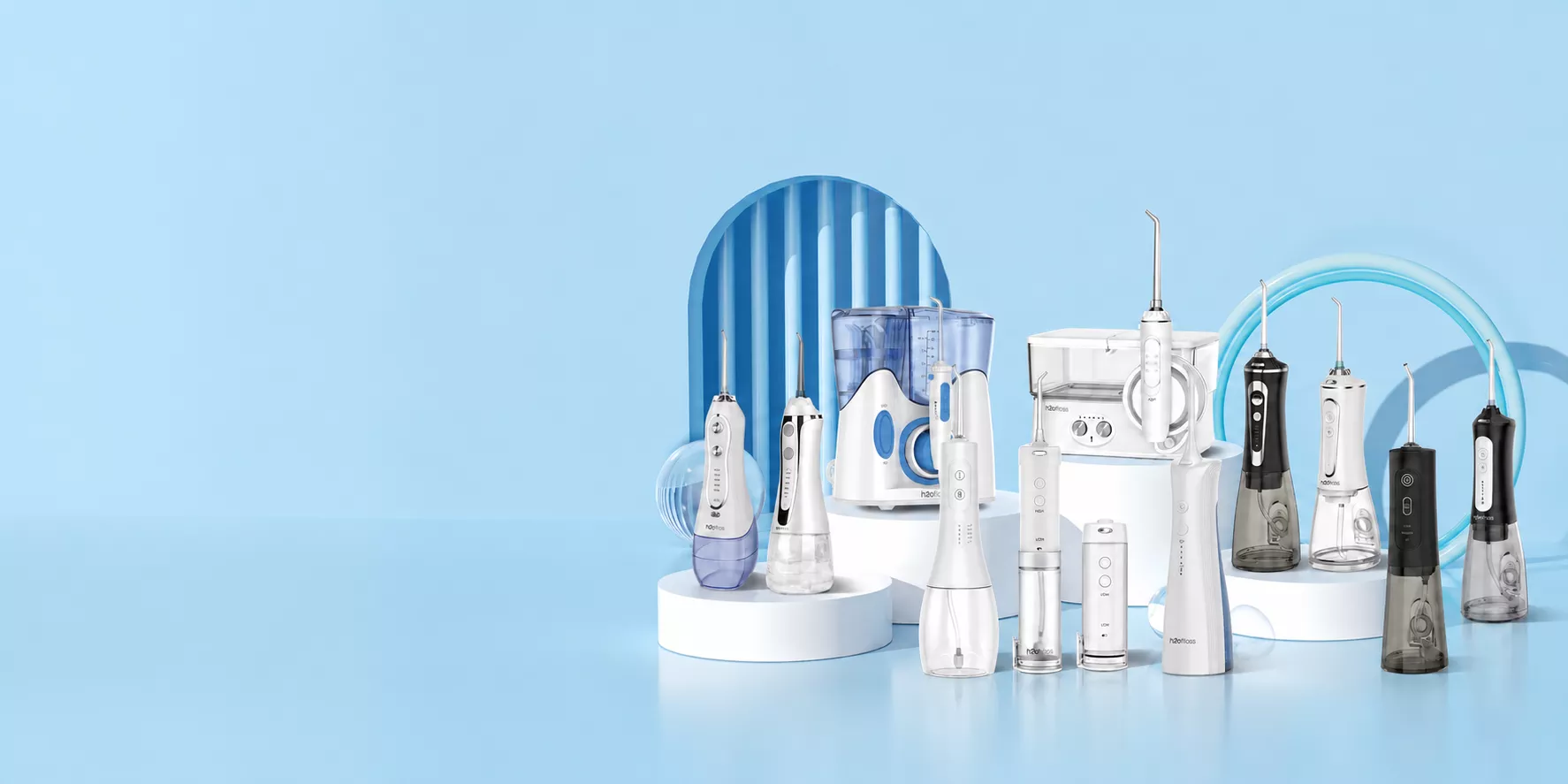
HF-6 and HF-10MINI both list a 40–130 PSI pressure range, yet they make different choices for a braces-care product range. The best water flosser for braces needs a suitable compatible nozzle, controllable positioning around brackets and a body that fits the customer’s routine. A matching pressure range settles only one part of that choice.
For brands and product selectors, the useful question is which configuration makes those requirements easier to meet. The three BFT designs below offer distinct hardware advantages, from a separate handpiece and lower specified pressure starting point to different balances of onboard water and handheld weight.
Can You Use a Water Flosser With Braces?
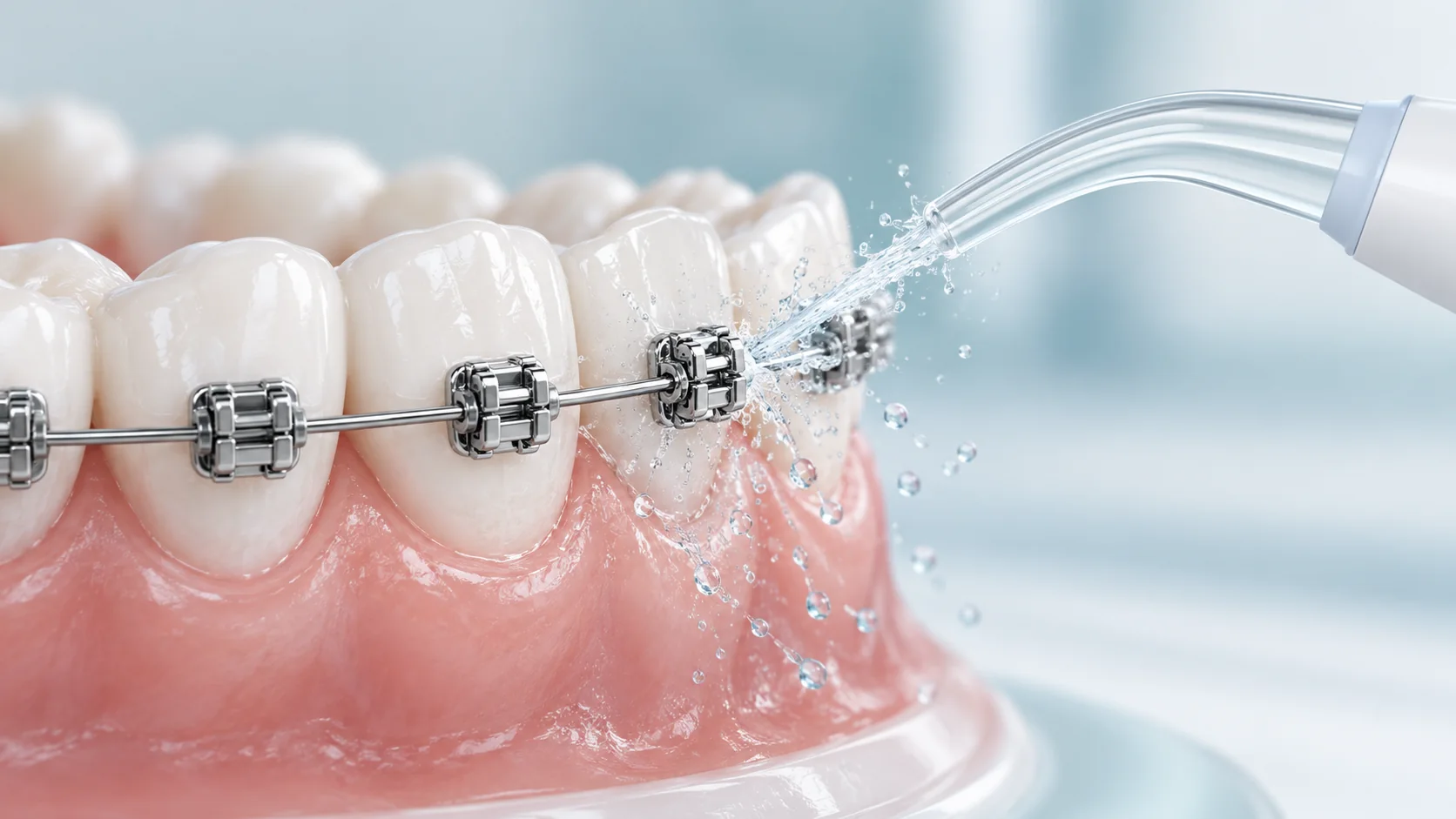
Yes. The American Dental Association identifies water flossers as an option for people whose braces make manual flossing difficult. They can be used alongside brushing and the interdental-cleaning routine recommended by the treating dental professional.
The appliance adds an operating challenge: the user must move around brackets and wires while directing the stream along the gumline and between teeth. That makes nozzle access and control more relevant than maximum pressure or the number of accessories in the box.
Three BFT Configurations and Their Best-Fit Conditions
Shortlist HF-7 when a separate handpiece and lower specified pressure starting point take priority. Choose the HF-6 direction when onboard water capacity matters more than retractable storage. HF-10MINI is the more relevant direction when compact storage and a lower estimated filled weight are priorities. These choices depend on an appropriate nozzle configuration for braces.
BFT lists its Standard Nozzles range for cleaning around braces and names HF-7, HF-6 and HF-10MINI among the compatible models. This provides a common accessory range for the comparison; the individual nozzle supplied for braces care and its operating instructions still need to be specified in the final configuration. The five- or eleven-nozzle bundle count does not identify that pairing.
| Model and design | Reason to shortlist it | Relevant configuration | Trade-off |
|---|---|---|---|
| BFT HF-7 Countertop |
A home-care range where a separate handpiece and lower specified pressure floor matter. | 5–110 PSI; 1,000 mL reservoir; hose-connected handpiece. | The base needs counter space and a suitable power supply. The listed configuration is AC 220 V, 50/60 Hz. |
| BFT HF-6 Fixed-body handheld |
A cordless range where carrying more water during use takes priority over retractable storage. | 40–130 PSI; five modes; 300 mL reservoir; 320 g body. | The user holds the filled reservoir throughout cleaning; the body keeps its shape when packed. |
| BFT HF-10MINI Telescopic handheld |
A compact adult-care range where the device is regularly packed away. | 40–130 PSI; five modes; 200 mL reservoir; 280 g body; Type-C charging. | Less onboard water than HF-6, with an extend-and-retract step between use and storage. |
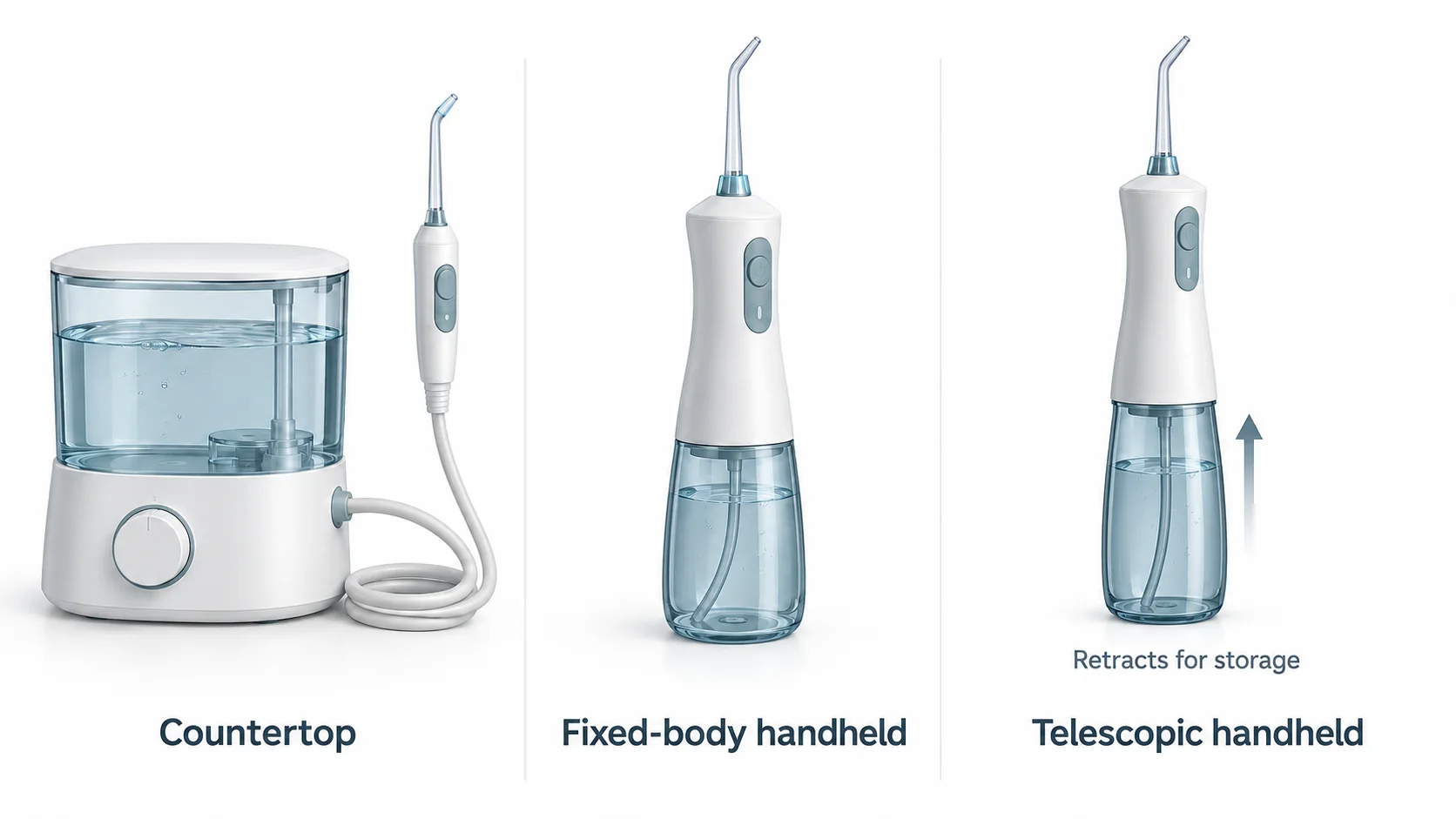
These differences support hardware selection. Choosing one of the three as a better plaque-removal performer would require a comparison of the complete device-and-tip combinations under the same conditions.
What Matters Most Around Brackets and Wires?
For braces, prioritize a nozzle suited to the intended cleaning task and enough control to move it tooth by tooth. Then weigh the pressure starting point, the load held in the hand and interruptions during use. Storage convenience becomes a deciding factor once those operating needs are met.
Tip Design and Access Around Braces
A tip has to approach the gumline and the spaces around the appliance while the user changes its angle. A narrow jet nozzle and a brush-ended orthodontic tip involve different actions. Waterpik’s braces-cleaning instructions, for example, describe gently brushing around brackets with its tapered orthodontic tip; they also identify a precision jet tip as an option.
The BFT Standard Nozzles compatibility listing connects the accessory range to all three bodies. It does not establish that every nozzle in the range has the same purpose, or that a BFT nozzle should use Waterpik’s brush-tip technique. The selected tip’s own instructions govern its angle and motion.
This is where accessory choice can outweigh an extra pressure mode. A tip intended for the task gives the user a defined way to work around the hardware. Additional nozzles with unrelated functions add little to that particular product proposition.
Pressure Control Starts at the Low End
HF-7 starts at a specified 5 PSI, while both handheld models start at 40 PSI. When the product brief calls for a lower pressure starting point, HF-7 is therefore the clearer hardware candidate. Its 110 PSI maximum does not make it a weaker choice for that requirement than a 130 PSI handheld.
A pressure endpoint is not a comfort rating. The nozzle and the steps between settings affect what the user experiences, and no single PSI value is established here as ideal for everyone wearing braces. Start low according to the device instructions and increase only as appropriate.
For HF-6 versus HF-10MINI, the shared range and five-mode specification offer no reason to call either one better at cleaning around brackets. Their meaningful published differences lie in body design, water storage and weight. That is where the selection should move next.
A Separate Handpiece Changes the Load You Hold
Cleaning inner surfaces and reaching back teeth requires changes in wrist and nozzle angle. HF-7 leaves its water reservoir and main body on the counter while the user moves a separate handpiece. HF-6 and HF-10MINI keep the motor and water supply in the unit being held.
If holding a filled device is the main handling concern, a countertop configuration deserves priority over a smaller packed size. The compromise is a hose and a base that need room beside the sink. A handheld removes that setup, but the user carries its water throughout the cleaning sequence.
The wider cordless vs corded water flosser comparison explains how power supply and body format affect a product range. For braces care, the important connection is whether the format helps the user keep directing the tip accurately as they move around the appliance.
Water Storage Matters Through Cleaning Continuity
A bracket-by-bracket routine involves pauses and changes of direction. Running out of water adds a refill and restart to that sequence. A larger reservoir can reduce those interruptions only when its usable volume is considered alongside the selected mode’s water flow.
Approximate continuous water-on time = usable water volume ÷ average flow rate.
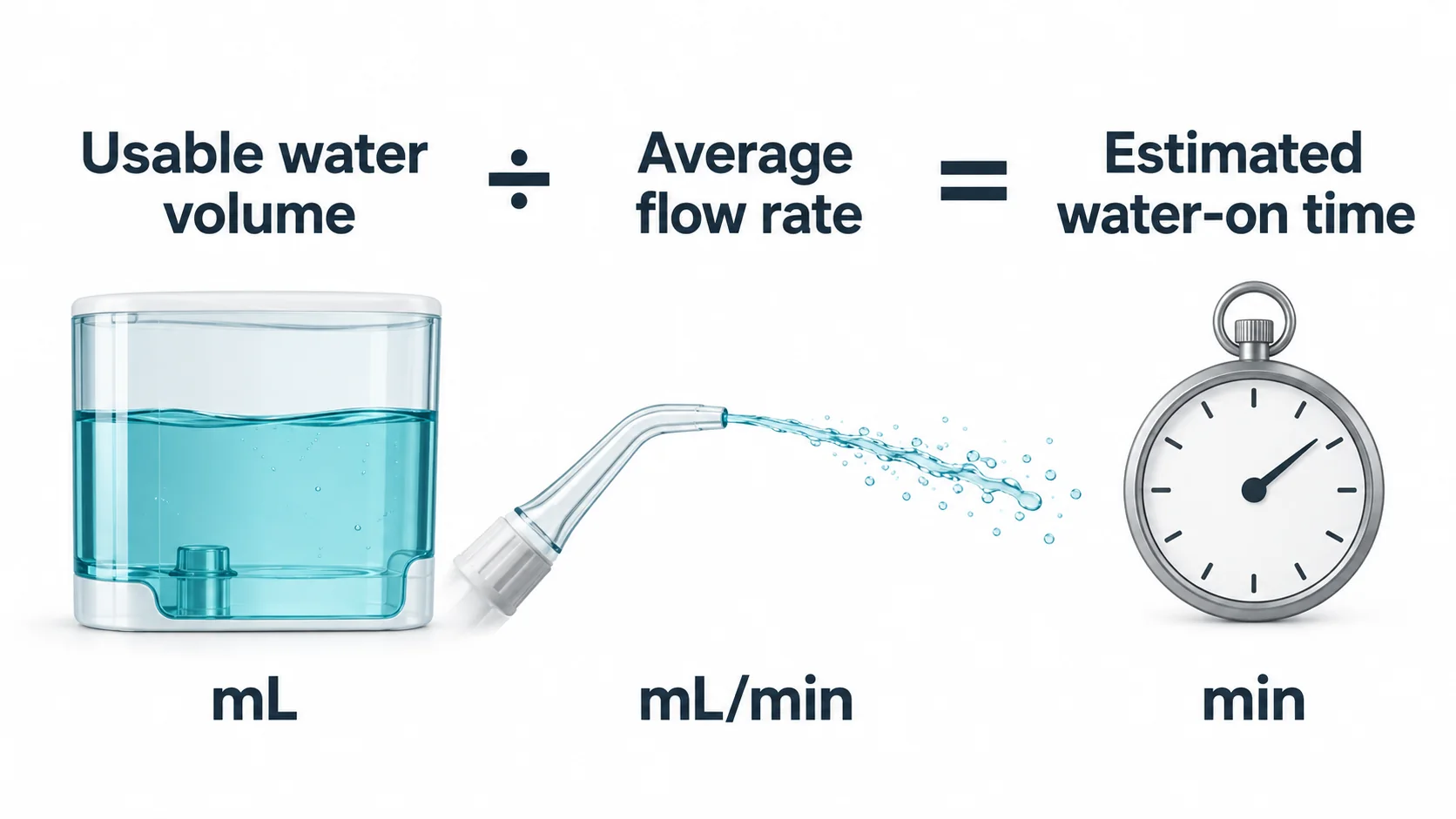
HF-6 has 50% more nominal water capacity than HF-10MINI: 300 mL versus 200 mL. At the same average flow and usable-volume proportion, that would provide 50% more continuous water delivery. It does not establish either model’s actual cleaning time or refill count.
For a customer who stops repeatedly before completing the prescribed sequence, extra usable water has a clear purpose. For someone who accepts a refill in exchange for carrying a lighter handheld, the smaller reservoir may be a reasonable choice. Capacity earns its place through that trade-off, rather than through a larger number on the specification sheet.
Choosing a Portable Water Flosser for Braces
The best portable water flosser for braces must remain manageable during cleaning as well as convenient to carry. HF-6 and HF-10MINI share the stated pressure range, mode count and Standard Nozzles compatibility. The deciding differences are how much water the customer wants to hold and how the device needs to store.
More Water on Board or Less to Hold?
The empty-body difference is 40 g: HF-6 weighs 320 g and HF-10MINI 280 g. Adding water to their nominal capacities gives a more useful handling estimate:
- HF-6: about 620 g, from a 320 g body plus approximately 300 g of water.
- HF-10MINI: about 480 g, from a 280 g body plus approximately 200 g of water.
These capacity-based estimates exclude the nozzle and assume roughly 1 g per mL of water. They put the initial load difference near 140 g when filled to nominal capacity; the load falls as water is used.
That gives the choice a practical basis. HF-6 offers more water carried through the routine, while HF-10MINI offers a lower estimated initial load. Neither fact demonstrates better tip access, but both matter when the user must hold the unit steady while moving around brackets and back teeth.
Retractable Storage Has a Specific Job
HF-10MINI’s telescopic construction addresses repeated packing and storage. BFT also identifies this model for adults with braces. Its design is worth prioritizing when the customer has a real reason to retract the device regularly; it adds an operating step that a fixed-body handheld does not need.
A telescopic main body still needs space for the nozzle and charging equipment. HF-10MINI uses Type-C charging; the HF-6 connector needs confirmation for the supplied version. Compare the complete kit when charging or packed size is a deciding requirement.
When operating control and the intended nozzle are suitable, choose between these handhelds on the remaining conflict: more onboard water, a lower filled load, or retractable storage. Peak pressure cannot resolve that choice because the stated endpoints are the same.
How to Use a Water Flosser With Braces
A simple tooth-by-tooth sequence helps explain why positioning and control matter. Follow the selected device and nozzle instructions; use brushing movements only with a brush-ended tip whose instructions specify them.
- Prepare: fill with lukewarm water to the specified level and attach the appropriate compatible tip.
- Position: select a low setting, lean over the sink and place the tip in the mouth before switching on. Let water drain into the sink.
- Work around the appliance: start at the back, follow the gumline and move tooth by tooth, pausing between teeth and around brackets as directed.
- Finish the sequence: include inner and outer surfaces, then switch off before removing the tip. Empty and maintain the device according to its instructions.
Waterpik’s illustrated technique above and Oral-B’s positioning instructions provide useful examples. A refill should not cut short the cleaning sequence recommended by the treating dental professional.
FAQs
These remaining questions concern the care routine and accessory choice.
Can a Water Flosser Replace String Floss With Braces?
The orthodontic-care plan should determine whether string floss, a threader or an interdental brush is still needed. The American Association of Orthodontists discusses several cleaning tools for fixed appliances; selecting a water flosser alone does not settle the combination for an individual mouth.
How Often Should an Orthodontic Tip Be Replaced?
Follow the interval for the selected tip: Waterpik specifies three months for its orthodontic tip, with wear affecting replacement. That interval should not automatically be applied to BFT accessories, whose own care instructions govern replacement.
Can Adults and Children With Braces Use the Same Model?
Only when the model’s age range, supervision requirements and instructions support both groups. HF-10MINI’s adult-braces use statement does not establish child suitability, and a small body or low setting alone is insufficient to make that recommendation.
For a BFT braces-care range, make the first choice around the operating need that matters most: lower pressure adjustment, less weight in the hand, or more water available during the sequence. Give the next model a place only when it answers a different customer need; a different maximum-PSI number alone is a weak reason to expand the range.