Choose a water flosser manufacturer by verifying the production site, testing the quoted model and checking the documents for your sales market. For US and European private-label buyers, confirm the minimum order per color, development fees and delivery dates before accepting a quote.
A low unit price can lose its appeal if a color minimum requires more stock than expected or a missing test delays your launch. The supplier questions and scorecard below help you check the offer before you commit.
1. Verify Water Flosser Manufacturing Experience
A reliable water flosser manufacturer should be able to show completed projects similar to yours and explain the work its team performed. A useful example covers the original brief, design or branding changes, a problem solved and what reached production.
Ask the supplier:
- “Can you show a completed water flosser project with a similar format or customization scope?”
- “What did your team develop or change for that project?”
- “Can you walk us through a development or production problem your team solved?”
Request: a short project example with the original brief, sample or product photos, the work completed and the solution to a development or production problem. Confidential customer names can be removed.
How to decide: look for an explanation of a real design or production problem and how the team solved it. A catalog and a founding date give you less insight into how the factory will handle your project.
2. Audit the Water Flosser Factory
A water flosser factory audit should verify who makes the product, where production takes place and which operations are handled on site. Match the supplier’s legal name and production address to business records, then use a live video tour or an on-site visit to check the manufacturing operation.
Ask the supplier:
- “Are you the manufacturer, a trading company or the sales company for a related factory?”
- “At which address will our model be made?”
- “Which production steps for this model are subcontracted?”
- “Can you show a live walkthrough of the assembly, testing and packing areas?”
- “Which quality checks are completed before the products reach packing?”
Request: the supplier’s business registration details, the actual factory address and current production photos. Follow up with a live walkthrough or an on-site audit; photos alone do not establish who operates the factory or show how it currently works.
During the tour, follow the proposed model through its main production steps. Ask to see the leak-check process, a recent batch inspection record and how repaired units are retested.
How to decide: the seller’s identity, manufacturing location and responsibilities should be clear and consistent with the evidence. If the seller and factory are different companies, establish their relationship and agree who is responsible for quality, documentation and warranty claims.
3. Check Water Flosser Compliance Documents
Water flosser compliance documents should cover the model, battery, charger and target market in your order. Check which reports and declarations apply to that configuration, and have any gaps or design changes reviewed before finalizing branded packaging.
- EU: request the EU Declaration of Conformity and the technical evidence supporting it. The EU’s CE marking guidance explains the manufacturer’s responsibilities.
- US: establish which FDA registration/listing, electrical and electromagnetic requirements apply to the product and its intended claims.
- UK: confirm the accepted marking route for the product and destination; Great Britain and Northern Ireland have different frameworks.
Ask the supplier:
- “Which documents cover the exact model and charging accessories in this quote?”
- “What additional testing is needed for our target countries?”
- “What needs updating for our brand name or requested design changes?”
Request: a document list connecting your model to the relevant reports, declarations and responsible companies, plus a plan and price for any additional testing.
How to decide: resolve unexplained model or company-name differences before relying on a document. A different name can have a legitimate platform-owner explanation; verify the relationship rather than assuming either approval or fraud.
4. Compare Water Flosser Sample Performance
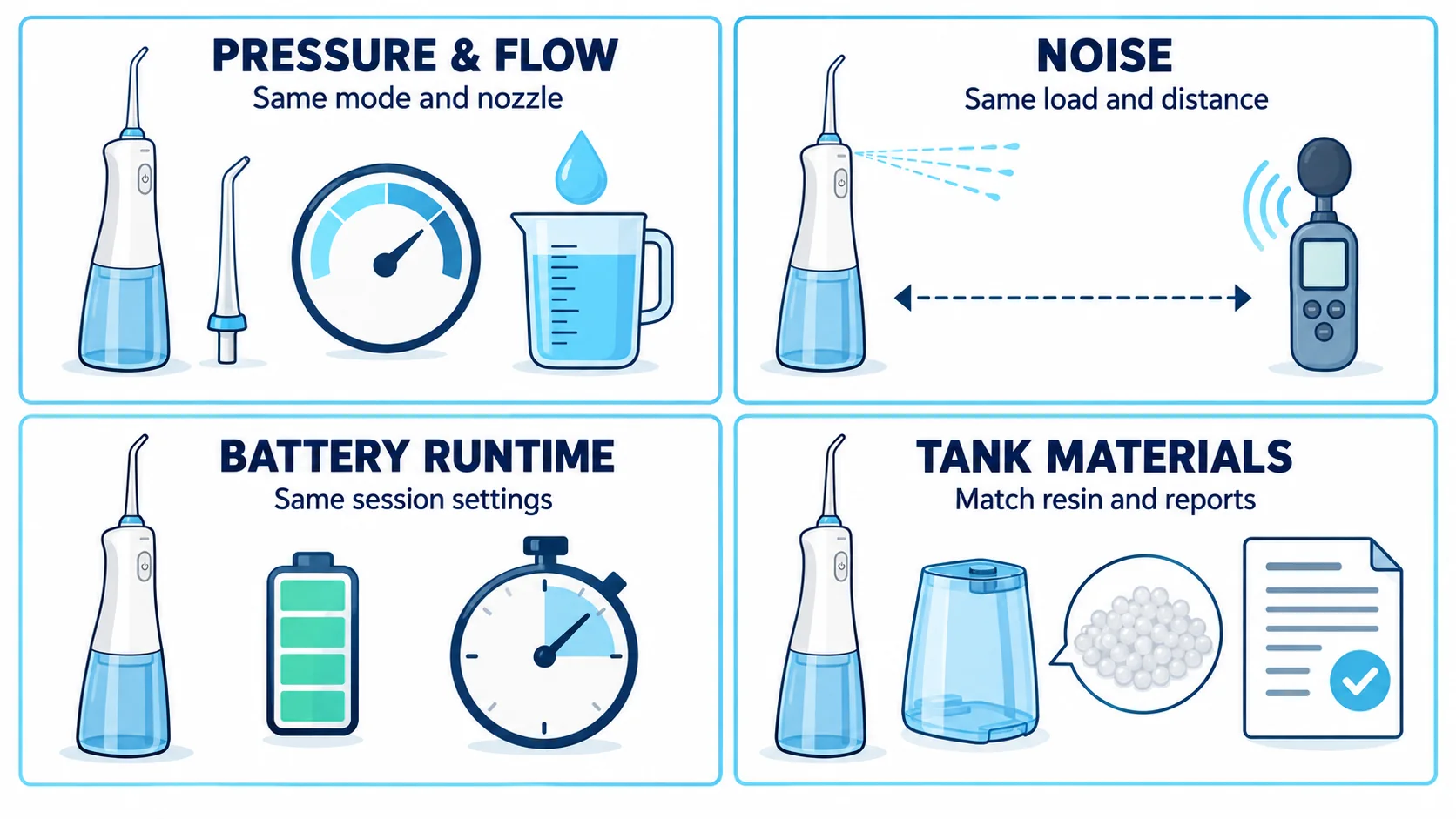
Water flosser sample testing should use the model and accessories in each supplier’s quotation, with shared methods and agreed acceptance limits. Compare pressure and flow, runtime, noise and tank performance before approving the product for sale.
Compare pressure and flow
Compare water flosser pressure and flow using the same method. Record both measurements for the proposed mode and nozzle before judging which sample meets your requirements.
Ask the supplier:
- “Which operating mode was tested?”
- “Which nozzle was used?”
- “Where was pressure measured?”
- “Is the quoted pressure a peak or sustained reading?”
- “What flow rate was recorded under those conditions?”
Request: results showing the model, setup, pressure in PSI or kPa, flow in mL/min and repeated readings.
How to decide: request a common test method if the results are not comparable. Once the conditions match, judge the sample against your agreed limits; a maximum PSI figure alone is an incomplete comparison.
Check battery capacity and runtime
Check how long the water flosser runs under the advertised usage schedule. The battery’s capacity in mAh is only one part of the comparison.
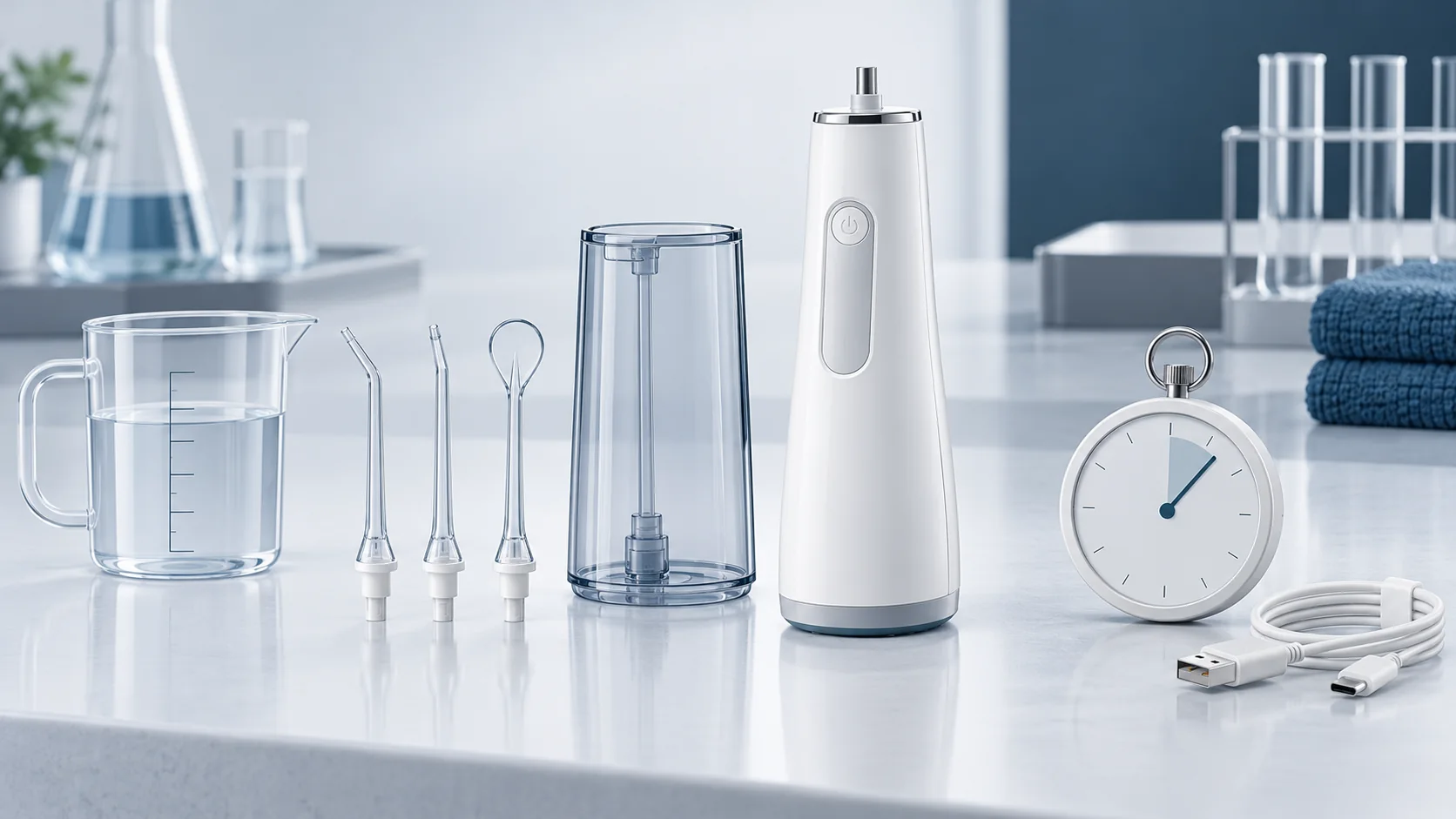
Example: “30 days per charge”
- One two-minute session per day: 60 minutes of operation over 30 days.
- Two two-minute sessions per day: 120 minutes over 30 days.
Both schedules cover 30 days, but twice-daily use requires twice the runtime—so ask which schedule supports the supplier’s claim.
Ask the supplier:
- “What usage schedule supports the battery-life claim?”
- “Does the runtime test end at shutdown or at a specified minimum output?”
Request: the runtime result and test conditions, plus the battery specification. The schedules in the example are illustrative assumptions.
How to decide: approve the usage conditions behind the claim you intend to print.
Compare operating noise
Compare water flosser noise levels under the same measurement setup. A hypothetical 60 dB(A) result at one meter cannot be ranked directly against 65 dB(A) measured at half a meter.
Request: the sound metric, microphone distance, operating mode, water load and background conditions. Ask for a repeat under one shared setup when those conditions differ.
Check tank material and nozzle fit
Check the water flosser’s reservoir material and assembled parts, including the valve, seals and nozzle lock. A general “BPA-free” statement does not identify the resin in the quoted tank or demonstrate that the assembly will resist leakage.
Ask the supplier:
- “Which resin grade is used in the tank?”
- “How is the assembled tank checked for leaks?”
- “How is nozzle retention checked after repeated use?”
How to decide: agree suitable handling and use-cycle checks, then resolve leaks, poor retention or material mismatches before approval. Arrange electrical-safety and ingress qualification through an appropriate laboratory.
5. Define OEM and ODM Support
Compare water flosser OEM and ODM offers by the design work, tooling, testing and branding included in the price. Confirm whether the project uses an existing product or requires new engineering before agreeing on charges and delivery.
Ask the supplier:
- “Which requested changes require new development?”
- “What will each sample stage allow us to evaluate?”
- “Who will own the paid molds and design files?”
- “What confidentiality or exclusivity terms are available?”
Request: a change list, deliverables, sample stages, development charges and written tooling and confidentiality terms.
How to decide: approve a sample for the work it actually demonstrates. An appearance model can settle color and shape while performance testing or final materials remain unfinished.
6. Check Water Flosser MOQ Flexibility
Confirm the minimum order quantity for water flossers by model, color and packaging version before planning launch inventory. Ask whether variations can share one minimum, since a low advertised MOQ may apply separately to each color.
Ask the supplier:
- “Can the quoted MOQ cover our planned color and packaging mix?”
- “Which standard options would lower the minimum?”
- “Are reorder minimums different from the first order?”
Example: MOQ by color
You plan to order 1,000 water flossers in three colors. If the supplier’s MOQ is 1,000 units per color, you would need to order 3,000 units in total. The unit price may stay the same, but you would be buying three times your planned quantity.
Request: the minimum and price for the exact model/color/packaging split you intend to order, plus the terms for smaller reorders.
How to decide: compare the whole order commitment. A simpler first range may fit your cash flow better than a lower unit price that requires more inventory.
7. Compare the Full Order Cost
Compare water flosser quotations at the quantity and pack contents you intend to buy. Include one-time development costs and the delivery costs outside the supplier’s price before calculating your first-order budget.
If one quote includes four tips and a branded box while another includes two tips and a plain box, ask both suppliers to price the same package.
Ask the supplier:
- “What is included in the unit price?”
- “Which development or testing costs are charged separately?”
- “Which freight or delivery costs are excluded?”
Separate unit prices from sample, engineering, tooling, testing and delivery charges. For an illustrative $1,000 development fee, the allocation is $1 per unit across 1,000 units, or $0.20 across 5,000 units; the first order still needs to fund that fee.
Request: an itemized quotation showing what is included, one-time charges, payment milestones and the trade term with its named delivery point.
How to decide: compare the cost at your intended volume. Identify which freight, insurance, clearance and local delivery costs remain outside the supplier’s offer before calculating your margin.
8. Confirm Production Capacity and Delivery
A water flosser production schedule should state when your order can enter production and when it will be ready to leave the factory. Check the available slot, approval deadlines and inspection time; monthly capacity alone does not establish a delivery date.
Ask the supplier:
- “Which approvals and payments start the quoted lead time?”
- “Which production slot is available for our order?”
- “How much time is allowed for inspection and corrective work?”
- “How would you schedule a reorder if demand rises?”
Request: dates for approvals, material readiness, production, inspection and factory release. Add transport and customs to your own launch plan.
How to decide: judge whether the milestones fit your launch, including time to fix a failed inspection. Prototype, production and warehouse-delivery dates describe different parts of the project.
9. Agree Warranty and Spare-Part Support
Water flosser warranty terms should explain how confirmed defects will be investigated and remedied after delivery. Confirm replacement timing, freight responsibility and access to compatible tips so you can plan customer support and replacement stock.
Ask the supplier:
- “What evidence is needed for a quality claim?”
- “When will replacements or credits be issued?”
- “Who pays freight for confirmed defects?”
- “How long will compatible replacement tips be available?”
Request: the warranty scope and start date, claim process, remedy timing, spare-part references and approval rules for component changes.
How to decide: check whether the remedy meets your customer-service needs. A credit toward a future purchase and replacement units available now have different effects on your cash flow and support stock.
Water Flosser Supplier Red Flags
Water flosser supplier red flags include unverifiable production details, unsupported documents and unresolved failures against agreed product limits. Pause an order while a genuine discrepancy is investigated; reject a supplier that fabricates evidence or refuses the corrective work your order requires.
- Unclear production identity: the seller will not identify who manufactures the quoted model.
- Unexplained document conflicts: reports name another product or company, and the supplier cannot substantiate the relationship.
- Uncontrolled substitutions: the supplier will not agree how pump, battery or other important changes will be disclosed and approved.
- Unresolved sample failures: the product misses agreed limits, with no correction or retest plan.
- No inspection or remedy agreement: the supplier refuses the inspection access or written defect-handling terms your order requires.
- Shifting commercial terms: MOQ, extra charges or lead-time start conditions remain unclear after a written request.
A lower price warrants a closer look at the offer’s contents and evidence. Price alone does not establish that a factory is dishonest or that its product is unsuitable.
Water Flosser Supplier Scorecard
Use this water flosser supplier scorecard to compare the evidence and commercial terms for one specific order. Factory verification, quality control, market documentation and sample results are approval checks; price or delivery advantages cannot make up for an unresolved requirement in those areas.
Score each row 0 for missing or unacceptable evidence, 1 for a partial or conditional answer, and 2 when the requirement is confirmed for your order. Gate rows are required checks; Fit rows cover whether the offer works for your project.
| Checkpoint | What earns 2 points | Type | Score |
|---|---|---|---|
| Factory and experience | Actual manufacturer identified; relevant work substantiated. | Gate | __/2 |
| Production quality control | Routine checks, batch evidence and failure handling reviewed. | Gate | __/2 |
| Market documentation | Coverage of the ordered model and market verified. | Gate | __/2 |
| Sample performance | Comparable results meet agreed product requirements. | Gate | __/2 |
| OEM/ODM scope | Changes, deliverables, ownership and approvals agreed. | Fit | __/2 |
| MOQ flexibility | Model/color/package quantities fit the purchasing plan. | Fit | __/2 |
| Total order cost | Comparable quotation and known extra charges fit the budget. | Fit | __/2 |
| Capacity and delivery | Production milestones fit the required delivery plan. | Fit | __/2 |
| Warranty and parts | Written remedies and parts arrangements fit support needs. | Fit | __/2 |
Do not approve a bulk order while a gate check is unresolved. A score of 16/18 with zero for market documentation is still an incomplete evaluation. Commercial terms must also meet your hard budget and delivery requirements, regardless of the total.
The score is a purchasing aid, not a product certification or a prediction of future defect rates. Keep the document or sample reference behind each mark.
Make Your Final Supplier Choice
Select a water flosser manufacturer only after the sample, market documents and production checks meet your requirements. Use one final RFQ with identical pack contents and quantity splits to compare MOQ, total cost, delivery and after-sales terms across the shortlisted suppliers.
Before the production order is signed, reference the accepted sample, final specification, artwork, inspection requirements and approved-change process. Use that same agreement when you reorder.
FAQ
How do water flosser OEM and ODM differ?
OEM generally means manufacturing to a buyer’s requirements, while ODM includes design support from the supplier. Factories use these labels differently, so establish whether you are branding an existing water flosser, changing its features or commissioning a new design before agreeing on charges and ownership.
Does FDA registration mean FDA approval?
No, FDA registration and device listing do not establish FDA approval or clearance, as the FDA’s registration guidance explains. Confirm the classification and applicable obligations for the water flosser and intended claims, rather than relying on a document sold or described as an FDA registration certificate.
Does ISO 9001 certify a water flosser?
No, ISO 9001 concerns quality management systems, rather than approval of a particular water flosser model. Review the certificate’s company, production scope and validity, then separately check the product test reports and market documents needed for the device you intend to sell.
What defect rate should I accept?
There is no universal defect-rate limit for every water flosser order. Agree defect severity and inspection acceptance criteria before production; NIST’s sampling guidance explains that sampling supports a lot acceptance decision, so a passed inspection does not prove that every unit is defect-free.
Why Choose BFT as Your Manufacturer?
Shenzhen Baofengtong Electrical Appliances Manufacturing Co., Ltd. (BFT) is a water flosser manufacturer with 16+ years of oral care manufacturing experience. Its in-house development, tooling, injection molding, assembly and quality control give brands a partner for both product changes and production.
| BFT capability | Why it matters for your project |
|---|---|
| 16+ years in oral care; customers in 70+ countries and regions. | Relevant category and export experience to discuss your market and product brief. |
| Design, engineering, tooling, molding, assembly and QC in-house. | Develop the product and coordinate production with the same manufacturing partner. |
| 10,000+ m² facility, 49 injection molding machines and reported capacity of 300,000+ water flossers/month. | A manufacturing base for initial orders and growth; confirm allocation for your actual schedule. |
| Prototype support with a published five-day lead time. | Early design review for suitable projects; confirm prototype scope, since tooling and validation have separate schedules. |
| Custom branding from 1,000 units; production guidance of 14–30 days after deposit and artwork confirmation. | Starting figures for planning an OEM order, subject to the model, quantity split and requested changes. |
BFT’s OEM and ODM services cover existing-product customization and new development. A brand can start with logo, color and packaging changes, or discuss a new design with the engineering team.
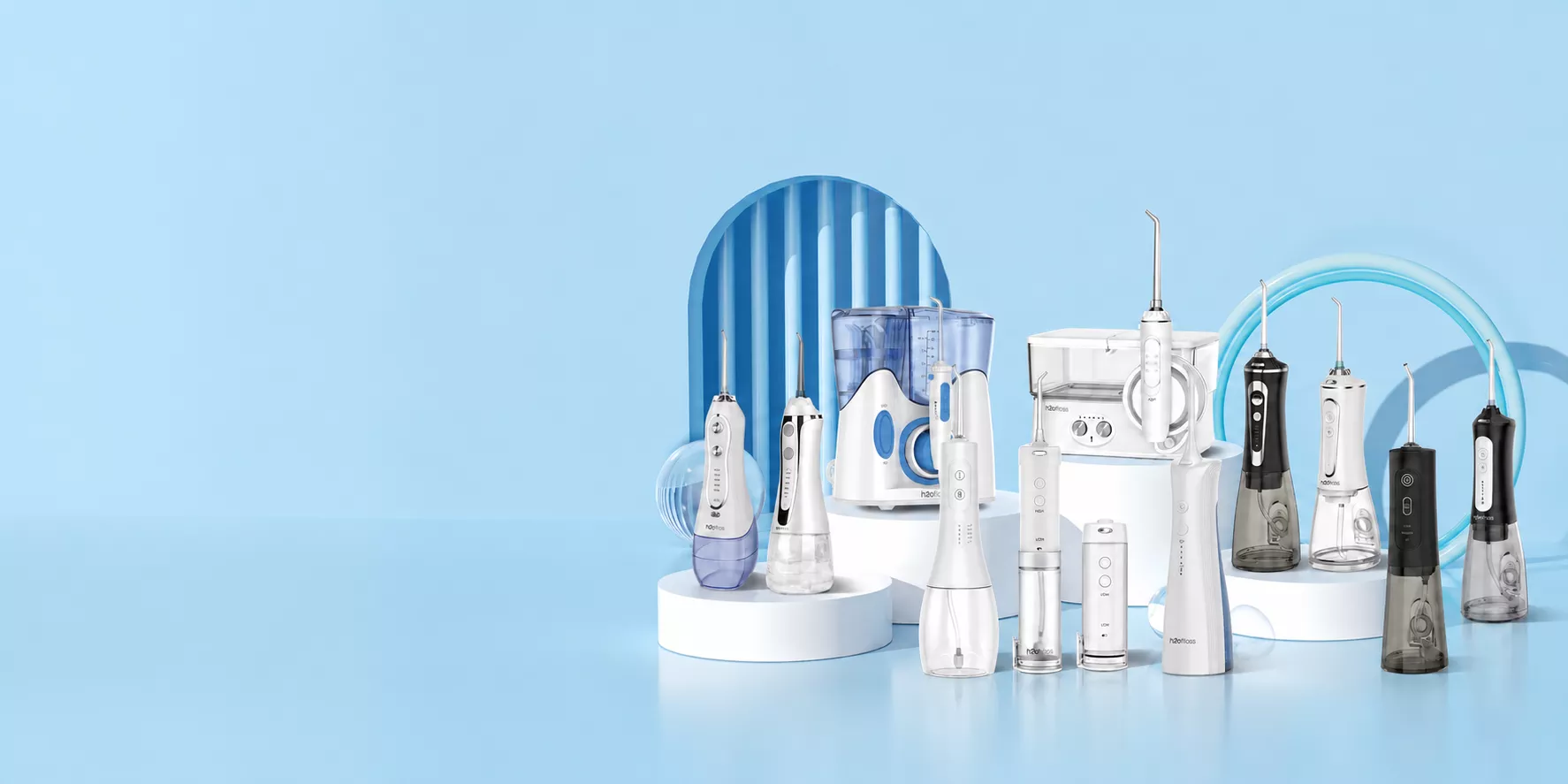
The BFT water flosser range includes cordless, countertop, travel and 2-in-1 formats. BFT also publishes a one-year warranty, with confirmed quality issues handled through later-order replacements or future-purchase credit; agree the applicable terms for your project.
Send your target countries, preferred product format, quantity by color and required delivery date when you contact the BFT team. Ask for a proposed model, sample plan and itemized quote, then use the same supplier checks to evaluate the offer.